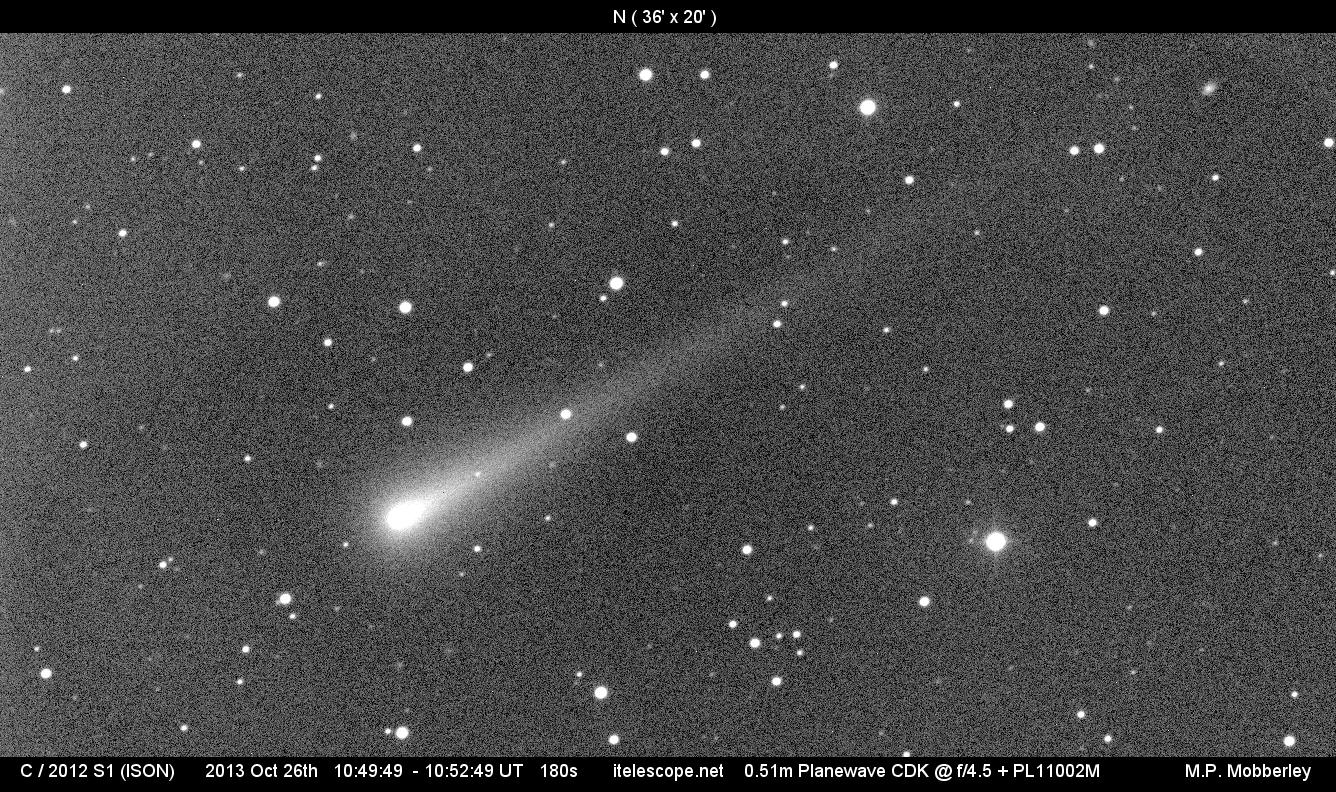
Comet ISON is still reasonably healthy in its current state. Between October 15th and 25th, ISON’s tail length increased considerably well. Mike Broussard was able to capture these two images of ISON and put them to scale for comparison.
Comet #ISON – size difference in 10 days – by Mike Broussard http://t.co/VRvT1pe2NX #cometison pic.twitter.com/iyRuSg2Qel
— Comet ISON (@CometISONnews) October 26, 2013
ISON still maintains its green coma, however, recent new images have shown some hues of red within its tail. The red hue is from ISON’s dust having a greater albedo (reflectivity) at much longer wavelengths. ISON remains intact and there is currently no evidence to suggest that ISON is breaking apart.
Photographer Justin Ng submitted this long-exposure image of ISON from October 23rd.
Comet #ISON imaged by Justin Ng on Oct 23rd https://t.co/Hao4u3JY8Y #cometison #longexposure pic.twitter.com/T5rn4TLUOP
— Comet ISON (@CometISONnews) October 24, 2013
For the past couple of days, and continuing on until Halloween on October 31st, moonlight has been causing interference in images. The images are usually noisy, but the images should improve after the 31st. Recent observations of ISON’s magnitude have been reported between 9.0 and 9.5.
Dr. Zdenek Sekanina from NASA’S JPL Laboratory, notes, “The comet continues to brighten at a sluggish rate, but has not run out of breath.”
If ISON becomes visible to the naked eye, it should become visible sometime between mid- to late-November. Otherwise, if ISON survives after perihelion on November 28th, it should then visible up until mid-December. Ideally, we will get to see ISON sooner and longer.
Here are a couple of news article snippets from the past couple of days.
ISON can now be seen with small telescopes and might soon be visible through good binoculars, but in recent months, sky watchers are a little less certain about the comet’s upcoming performance.
“We don’t know for sure what it will do,” said Carole Holmberg, planetarium director at the Calusa Nature Center and Planetarium in Fort Myers. “The initial predictions were that it would be extraordinary. But it hasn’t lived up to the hype.
It now seems almost certain that Comet ISON will fall short of the early, optimistic assessments (truth be told, it was never going to light up the night like the full moon, since peak brightness will happen while it is less than one degree from the sun…in the middle of the day). The dire predictions that the comet has fizzled are simply wrong, however. Recent Hubble images show it beautifully intact.
A recent study by Jian-Yang Li of the Planetary Science Institute gives additional reason for hope. Comet ISON is oriented such that one side has remained shadowed so far. When the comet whips around the sun on November 28, the comet’s night side will suddenly emerge into daylight and be hit with an intense blast of solar heat. That could potentially lead to a spectacular eruption of gas and dust.
We see new cometary visitors every year. But this one is a Sungrazer. Its path is slated to carry it within a million miles of the solar surface, perilously close, at the end of November. At this point it will be traveling at more than 800,000 miles per hour!
— The Bridgeton News, 10/20/2013 article by Kevin Lollar
You can see a timelapse video below, covering 93 minutes of imaging, again on October 21. It’s obvious ISON is still intact and it continues to bright, as it is currently about magnitude 9.
— Universe Today, 10/24/2013 article by Nancy Atkinon. Images by Cliff Spohn and Terry Hancock.
*
Comet ISON update for October 26, 2013,